Skewness and Kurtosis

In statistics, Skewness and Kurtosis describe the shape of a distribution curve. They are very useful in educational research, psychological testing, and classroom assessment—areas closely related to your work in education and research.
1. Skewness
Meaning
Skewness refers to the degree of asymmetry of a distribution around its mean.
If the data are not evenly distributed on both sides of the mean, the distribution is said to be skewed.
Properties of Skewness
Measures asymmetry of the frequency distribution.
In a perfectly symmetrical distribution, skewness = 0.
Indicates direction of deviation from normal distribution.
Shows the relative position of Mean, Median and Mode.
Helps identify extreme scores or outliers.
Used to check normality of data before applying parametric statistics.
Types of Skewness

1. Symmetrical Distribution
Mean = Median = Mode
Curve is perfectly balanced.
2. Positive Skewness (Right Skewed)
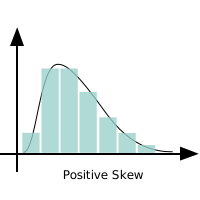
Tail extends toward right side.
Mean > Median > Mode.
Many low scores and few very high scores.
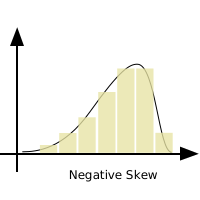
3. Negative Skewness (Left Skewed)
Tail extends toward left side.
Mean < Median < Mode.
Many high scores and few low scores.
Formula (Conceptual)
Skewness can be calculated using Karl Pearson’s coefficient:
or
2. Kurtosis
Meaning
Kurtosis refers to the degree of peakedness or flatness of a distribution curve compared with the normal distribution.
It shows how scores cluster around the mean.
Properties of Kurtosis
Indicates the shape and peak of the distribution.
Measures the concentration of scores around the mean.
Helps identify heavy tails or extreme values.
A normal distribution has kurtosis value ≈ 3.
Used in statistical analysis and test score interpretation.
Types of Kurtosis
1. Mesokurtic
Moderate peak.
Kurtosis = 3.
2. Leptokurtic
Highly peaked curve.
Data concentrated near the mean.
Kurtosis greater than 3.
3. Platykurtic
Flat curve.
Scores spread widely.
Kurtosis less than 3.
Formula (Conceptual)
Uses of Skewness and Kurtosis in Teaching–Learning Process
1. Evaluation of Test Scores
Teachers can understand whether:
Most students scored high
Most students scored low
Scores are normally distributed
2. Improving Question Papers
Positive skewness → test was too difficult
Negative skewness → test was too easy
3. Identifying Learning Differences
Helps teachers detect:
Slow learners
Gifted students
Performance gaps
4. Educational Research
Used in studies related to:
Attitude towards ICT
Intelligence and learning outcomes
(These types of statistical analyses are common in theses like the achievement motivation research you were working with earlier.)
5. Planning Remedial Teaching
If scores show skewness:
Teachers can modify teaching strategies
Provide remedial instruction
6. Validity of Statistical Tests
Researchers check skewness and kurtosis to decide whether parametric tests (t-test, ANOVA) can be applied.
Simple Summary Table
|
Concept |
Meaning |
Types |
|
Skewness |
Asymmetry
of distribution |
Positive,
Negative, Symmetrical |
|
Kurtosis |
Peakedness of distribution |


Comments
Post a Comment